

Forty-two percent of clients say they made a referral, yet advisors report receiving referrals from only about 4% of their client base. That gap exposes a practical problem: goodwill does not automatically become an introduction. Financial advisors find clients more reliably by documenting the referral process and supporting it with compliant digital marketing, strategic partnerships, direct outreach, and smooth onboarding.
Ask clients for referrals remains common advice. It works only when the firm removes the friction around acting on that request. A client can value an advisor, intend to recommend them, and still do nothing because the timing feels wrong, the request lacks specificity, or there is no clear next step.
A referral workflow should define who is most likely to refer, which client moments justify an ask, what language makes the recommendation easy, and where a prospect can respond. The firm should also record introductions, follow up consistently, and review which sources produce conversations and clients.
Relationship-based growth still matters, but systems-based acquisition makes it repeatable. Digital content and community presence give prospects additional ways to discover and validate the practice, reducing dependence on clients remembering to make an introduction.
Table of Contents
- The Referral Paradox in Financial Advisory
- Building a Repeatable Referral Workflow
- Creating Compliant Digital Marketing Assets
- Strategic Partnerships and Community Engagement
- Direct Outreach Scripts and Follow-Up Tactics
- Onboarding and Client Conversion Best Practices
- Transitioning to a Firm-Wide Growth System
The Referral Paradox in Financial Advisory
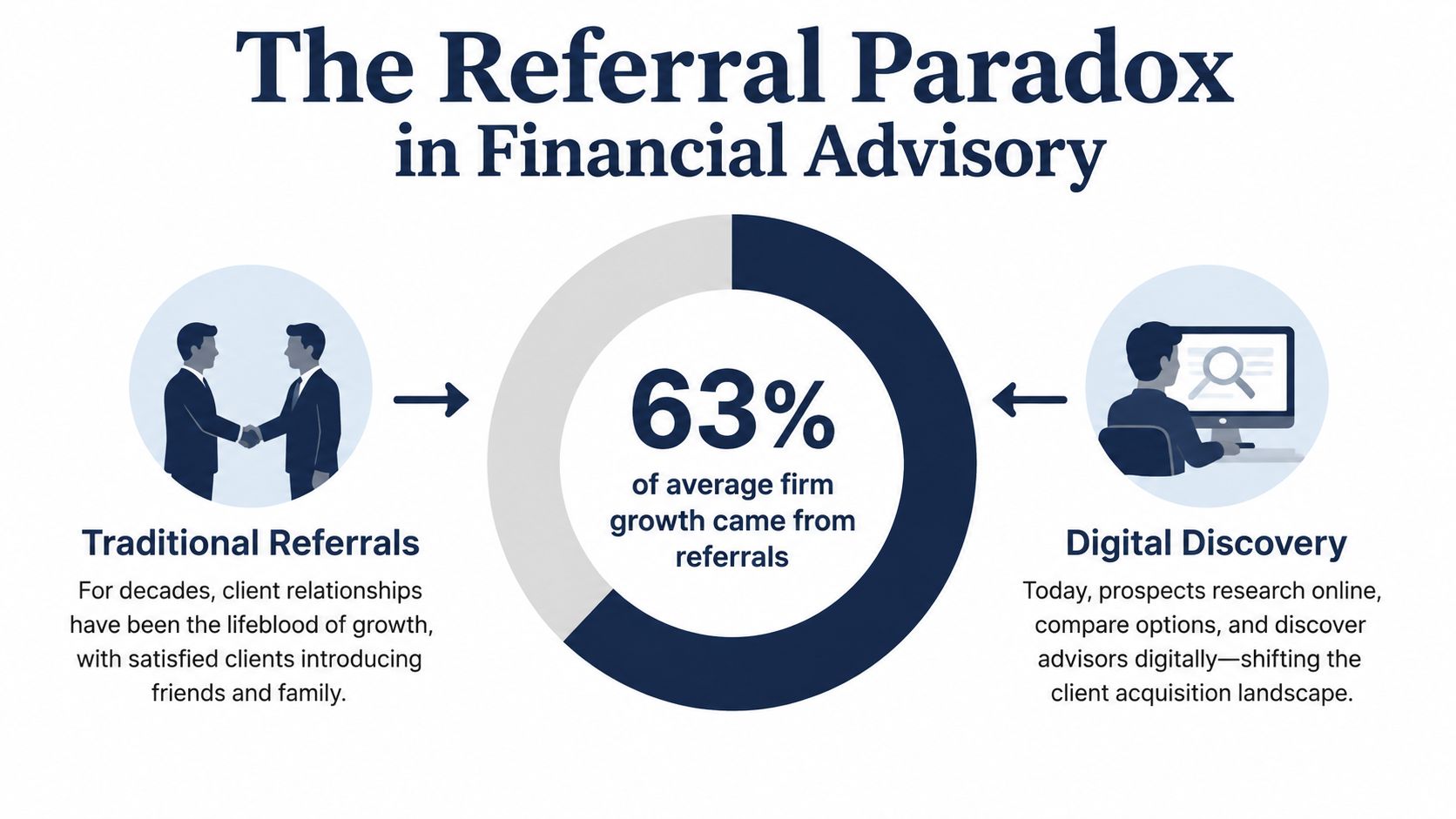
Referrals remain a major source of advisory growth, but goodwill alone does not produce a dependable pipeline. A 2019 survey found that 63% of the average advisory firm's organic growth came from referrals, while firms generated only about three new relationships from referrals for every 100 clients, or 4.5%. The same research found that 69% of clients considered an advisor's trustworthiness when choosing whom to work with, showing why personal recommendations carry unusual weight in financial advice. Kitces Research on advisor acquisition and marketing efficiency
The execution gap is substantial. Schwab's 2026 RIA survey coverage identified a sharp perception difference: 42% of clients said they made a referral, while advisors reported meeting referrals from only about 4% of clients. Clients may value the relationship and intend to recommend it, yet that intention often stops before an introduction. Coverage of Schwab's 2026 RIA survey
Why passive referrals underperform
Clients rarely have a referral task on their calendar. They mention an advisor after a friend, colleague, or family member raises a financial concern that matches the advisor's expertise. Broad positioning makes that moment harder to recognize, and “send anyone who needs financial advice” gives the client no practical language to use.
Specific referral readiness turns goodwill into an action. Clients should know whom the firm helps, which problems it addresses, and how to introduce someone without exposing sensitive information. A short introduction email, dedicated scheduling page, or educational resource can make the next step feel safe and straightforward.
The principle applies beyond financial services. A firm developing a referral-friendly audience can study how other businesses invite friends to Keyword Kick, without copying their mechanics, to see how a vague favor becomes a defined action.
Practical rule: A referral program works as a path from recognition to introduction, not a single request.
The 2019 and 2026 findings support the same operational conclusion. Trust creates willingness, while process converts trust into pipeline. Advisors who rely on spontaneous introductions will see uneven growth. Firms that assign ownership, create timely prompts, set follow-up standards, and measure outcomes can make referrals more dependable while preserving the relationship-driven experience. That system should sit alongside compliant digital discovery and other acquisition channels, rather than carrying the entire growth burden.
Building a Repeatable Referral Workflow
A referral workflow begins with the people who already influence the firm's ideal clients. Research on high-performing financial advisor teams identified three recurring themes: strong relationships and connectivity with referral sources, intentional interactions with those sources, and deliberate use of centers of influence. Academic research on high-performing financial advisor teams
Select the right referral sources
Start with a short list of 10 to 20 high-quality centers of influence, rather than a large contact database. The list might include professionals whose clients regularly face retirement, liquidity, succession, estate, or business-owner decisions. Quality matters more than volume because a referral source needs both access to the right audience and confidence in the advisor's judgment.
For each relationship, record:
- Audience fit: Which clients or communities does the person serve?
- Shared problem: What financial issue creates a natural reason to collaborate?
- Evidence of trust: What has the relationship demonstrated through prior conversations or introductions?
- Relationship owner: Which person at the advisory firm maintains the connection?
Define the ask
A vague request produces hesitation. A useful ask names the situation and gives the source language that can be repeated naturally:
“If a business owner mentions uncertainty about a future sale or succession decision, an introduction would be welcome. The first conversation can be educational, and there's no obligation to work together.”
The wording should reflect the firm's actual specialty. It shouldn't promise outcomes, imply guaranteed results, or pressure the source to disclose confidential client information.
Schedule value before asking for value
Referral sources need a reason to stay engaged. A recurring touchpoint could share a relevant planning checklist, invite the professional to a small educational session, or offer a concise explanation of a regulatory or planning issue affecting their audience. The interaction should provide usefulness even when no referral follows.
The firm also needs a tracking layer. Record the source, date of introduction, assigned advisor, first meeting, outcome, and next action. Advisors looking for more structured prospecting mechanics can review B2B referral automation tips, then adapt the underlying discipline to a regulated advice environment. A documented financial advisor referral program can help formalize ownership, messaging, and review procedures.
Measure source-to-client conversion by relationship owner, not merely the number of names received. That distinction shows whether the issue sits with the source, the advisor's response, the meeting experience, or the follow-up process.
Creating Compliant Digital Marketing Assets
A prospect who receives a referral will still inspect the firm before accepting a meeting. The website, search visibility, educational articles, and videos should answer three questions quickly: Who does the firm serve? What problem does it solve? Why should a prospect feel comfortable taking the next step? Digital assets support referrals by making the firm easier to evaluate, not by replacing trust with polished presentation.
Build around search intent
Start with questions real prospects ask. A firm serving executives might explain concentrated equity, liquidity planning, or retirement transitions. A firm serving business owners might address succession preparation, cash-flow decisions, or financial questions that arise before a sale.
Give each page one audience and one action. The action might be scheduling an introductory conversation, downloading an educational resource, or joining a relevant email list. Content should teach rather than disguise a sales pitch, and every statement should be supportable.
Educational video can make the firm more familiar before the first call. Short videos might explain a planning concept, outline the firm's process, or answer a recurring prospect question. Use plain language, avoid individualized advice for viewers, and direct viewers to a compliant page with appropriate disclosures.
The SEC's Investment Advisers Marketing Rule became effective on May 4, 2021, with a compliance date of November 4, 2022. It replaced the older fragmented framework with a modernized standard governing adviser advertising and related Form ADV changes. SEC final rule release

Treat testimonials as an operational process
Testimonials and endorsements are permitted only when the adviser satisfies applicable disclosure, oversight, and disqualification conditions. Advertisements must clearly and prominently state whether the promoter is a client and whether the promoter receives compensation. Advisers generally need a written agreement with promoters unless the promoter is an affiliate or receives de minimis compensation of $1,000 or less during the prior 12 months. SEC marketing rule announcement
Marketing and compliance therefore need one operating process. Each testimonial, endorsement, promoted post, video, landing page, and referral advocacy initiative should have an approval path, disclosure review, recordkeeping, and supervision.
Assign ownership before publication. A content calendar should identify the responsible advisor, reviewer, required disclosures, approval date, and retention location. This keeps the firm's acquisition system usable while reducing the chance that compliance must repair avoidable risks after content goes live. The objective is confidence grounded in accurate education, clear disclosures, and a consistent review process.
Strategic Partnerships and Community Engagement
Generic networking produces conversations. Strategic community engagement produces context, which is more valuable for an advisor whose work depends on trust and fit.
A hand-off approach usually looks like this: attend a broad event, exchange business cards, describe the practice in general terms, and hope the contact remembers the advisor later. This method can create awareness, but it often lacks a shared problem or a natural reason to reconnect. It also consumes time without making the firm's ideal audience more precise.
Community embedding works differently. The advisor chooses an ecosystem where the target clients already gather, then contributes before requesting introductions. A practitioner serving healthcare professionals might participate in medical association programming, provide a financial literacy workshop through a relevant nonprofit, or collaborate with specialists who understand the profession's planning pressures.
| Approach | What it creates | Main trade-off |
|---|---|---|
| Generic mixer | Broad familiarity | High activity, low relevance |
| Event sponsorship | Repeated visibility in a defined community | Requires budget and patience |
| Educational workshop | Demonstrated expertise and direct questions | Requires preparation and compliant materials |
| Niche professional partnership | Warm context and shared credibility | Depends on careful relationship development |
The strongest partnerships don't force a referral exchange. A tax professional, estate attorney, insurance specialist, or business consultant should see a clear benefit in introducing the advisor because the advisor improves the client's experience and respects the partner's role.
A useful engagement plan identifies the community, the issue the advisor can explain, the format that feels natural, and the follow-up owner. A workshop can lead to an educational resource. A sponsorship can lead to a conversation with organizers. A professional partnership can lead to a shared client-service protocol. Each activity needs a next step, or it becomes visibility without acquisition.
The advisor's role should remain that of a trusted resource, not an aggressive promoter. Prospects respond better when the interaction helps them understand a decision before asking them to begin an advisory relationship.
Direct Outreach Scripts and Follow-Up Tactics
Direct outreach earns attention through relevance. Generic pitches reach people who have no clear reason to respond, while a focused message connects a recognizable planning question with a useful next step.
A cold email should reference a legitimate professional context, identify an issue the recipient may recognize, and offer a modest action. For example:
Subject: A planning question for [professional group]
“A number of [professional group] professionals face competing decisions around [specific issue]. The attached checklist outlines questions worth raising with an advisor. If the topic is relevant, a short conversation can clarify whether the issue deserves attention.”
The message must respect the limits of what the advisor knows. Avoid implying access to the recipient's finances, unsupported performance claims, manufactured urgency, or a request for a full discovery meeting before trust exists. The advisor's role is to remain a trusted resource, helping prospects feel comfortable before asking for anything in return.
A LinkedIn message can be shorter:
“Your work with [industry or audience] caught attention because many people in that field eventually face [specific planning issue]. A practical resource on that topic is available if it would be useful. No meeting is needed.”
A focused financial advisor LinkedIn strategy should reinforce the same niche and client problems used in direct outreach. That consistency helps prospects recognize why the message is relevant.
Phone follow-up should acknowledge the earlier contact and make declining easy:
“This is [name]. A note was sent about [topic]. The purpose is to confirm whether that issue is relevant to your work. If it isn't, there's no need to respond.”
Outreach Script Framework
| Channel | Opening Approach | Call to Action |
|---|---|---|
| Cold email | Connect a specific audience to a recognizable planning question | Offer a resource or invite a brief reply |
| LinkedIn message | Refer to shared professional context without pretending familiarity | Ask permission to send an educational item |
| Phone follow-up | Confirm receipt and remove pressure | Ask whether the topic is relevant |
Silence does not always signal rejection. A measured sequence can include the initial message, a follow-up adding a different useful angle, and a final note that closes the loop. Each message should earn its place by adding information, clarifying relevance, or making the next action easier.
Advisors building an outbound process can study the operator's playbook for targeting, sequencing, and message discipline. Keep outreach aligned with the firm's compliance review and the SEC marketing rule, especially when educational content, testimonials, or endorsements enter the process.
Onboarding and Client Conversion Best Practices
A lead can disappear after a successful first conversation if the next steps feel uncertain. Prospects evaluate the advisory experience through small operational signals: response speed, document clarity, meeting preparation, and whether the advisor remembers the problem that prompted contact.
Make the first meeting concrete
Before the meeting, send a short agenda that explains what will happen and what the prospect should bring. The advisor should state the purpose of the conversation, distinguish education from personalized advice where appropriate, and explain what happens if the prospect appears to be a fit.
The first meeting should produce a useful outcome even when no engagement follows. That might be a clearer list of planning questions, a summary of information needed for analysis, or an explanation of the firm's service model. Immediate value demonstrates competence without turning the meeting into a pressure event.
Remove avoidable friction
A consistent onboarding workflow should assign ownership for each step:
- Qualification: Confirm the prospect fits the firm's service scope and minimum requirements.
- Discovery: Capture goals, concerns, decision context, and timing.
- Documentation: Request only the information needed for the next decision.
- Proposal: Explain services, fees, responsibilities, and expected communication.
- Agreement: Complete required paperwork through an approved process.
- First value milestone: Deliver an agreed planning action or service touchpoint.
Technology can reduce repetitive administration, but it doesn't replace judgment or compliance review. The firm should use approved systems, clear permission controls, and documented retention procedures.
Conversion standard: Every prospect should know the next action, the person responsible, and the expected timing before the conversation ends.
A smooth beginning also supports future advocacy. Clients are more likely to describe a firm clearly when they understand its process and can explain the specific problem it helped address. That makes onboarding part of acquisition, not merely an administrative handoff.
Transitioning to a Firm-Wide Growth System
The lead advisor can't remain the entire acquisition department. That model works only while the firm's relationships, content, follow-up, compliance review, and onboarding depend on one person's memory and availability. As the practice grows, individual charisma becomes a bottleneck.
A firm-wide system assigns acquisition responsibilities across the business. The lead advisor may define positioning and conduct key meetings. A client-service professional can identify suitable referral moments and maintain relationship records. A marketing specialist can manage content production and campaign reporting. Operations can maintain intake, scheduling, documentation, and handoff standards. Compliance can review the framework before campaigns go live, rather than becoming involved only after a problem appears.
Connect the channels
Each acquisition channel should perform a distinct job:
- Referral management converts existing trust into introductions.
- Digital content helps prospects discover the firm and evaluate its expertise.
- Community engagement creates repeated exposure within a relevant ecosystem.
- Direct outreach starts targeted conversations where the firm has a defensible reason to connect.
- Onboarding converts interest into confidence and a clear client relationship.
The channels shouldn't operate as separate campaigns. A referral source should be able to send a prospect to a relevant article. A workshop should direct attendees to a focused resource. An outreach message should point to a page that explains the firm's specialty. A discovery meeting should capture the original source and the issue that prompted contact.
Measure the operating system
A useful dashboard doesn't need to reward activity for its own sake. It should show where prospects enter, who owns the next step, how long a response takes, which source produces qualified conversations, and where prospects stop moving. The firm can then improve one constraint at a time.
Schwab's 2026 RIA survey coverage reported that client referrals were the top priority for firms and that firms with an existing referral plan generated 1.6 times more new client assets than firms without one. The same coverage described limited time and resources as a continuing barrier to organic growth. Schwab 2026 RIA survey coverage and referral-plan findings
That finding supports a broader conclusion: referral growth needs firm-level ownership, not just better wording in a client meeting. The 2024 marketing survey summarized by Kitces also found that nearly two-thirds of clients ultimately found an advisory firm through a referral, while client referrals were typically the source of nearly half of an advisor's new clients. Use of client referrals declined from 93% of advisors in 2019 and 2022 to 88% in 2024, showing that referrals remain central even as firms diversify. Kitces 2024 marketing survey report
Referrals aren't the only path. A 2024 study found that only 29% of consumers who hired a financial advisor required a personal referral when choosing one. 2024 Financial Advisor Growth Marketing Study The practical implication is diversification with discipline. A firm can prioritize referrals while building search content, educational video, partnerships, and targeted outreach for prospects who begin elsewhere.
The answer to how to find clients as a financial advisor isn't a single tactic. It's a coordinated operating model that makes trust visible, gives prospects a clear next step, and ensures every opportunity receives consistent follow-through.
Advisor Momentum helps financial advisors build compliance-ready websites, content programs, digital campaigns, video, coaching, and recruiting support around a coordinated growth system. Visit Advisor Momentum to connect client acquisition with compliant marketing execution and stronger onboarding workflows.
