

An advisor can publish a careful market update, answer prospective clients' questions, and explain a planning process clearly, yet still struggle to generate qualified conversations. The problem often isn't a lack of expertise. It's that the firm looks interchangeable online, reaches people before trust has formed, or sends a promising lead into a follow-up process that marketing and compliance teams haven't aligned.
That challenge now affects RIAs, wealth managers, bank marketers, and compliance officers at the same time. Financial decisions require more consideration than ordinary purchases, while the discovery process increasingly begins with search, mobile content, social media, and educational resources. A successful approach to marketing financial services must therefore connect brand credibility, useful content, carefully selected channels, measurable conversion paths, and documented review procedures.
Table of Contents
- Introduction to Marketing Financial Services Today
- What Marketing Financial Services Really Means
- Building a Compliant and Credible Brand Foundation
- Choosing Digital Channels That Drive Qualified Leads
- Content Programs and AI Workflows That Stay Compliant
- Measuring Performance and Scaling Your Go to Market Engine
- Your Next Steps for Marketing Financial Services With Confidence
Introduction to Marketing Financial Services Today
A prospective client may search for retirement guidance on a phone, read an educational article during a commute, watch a short explanation of investment risk, and only then decide whether to contact an advisor. The advisor may never know which early interaction created confidence. By the time a consultation request arrives, the prospect has often formed an opinion about the firm's expertise, clarity, and professionalism.
That pattern explains why digital marketing has become central to financial services. An industry report says 90% of loan and mortgage consumers, 85% of check cashing consumers, and 76% of tax return preparation consumers begin with an online search. The same financial services marketing statistics report reports that mobile searches related to financial planning and management rose 70% over two years. Search-first discovery changes the advisor's job. A firm's website and educational content must answer real questions before a salesperson ever enters the conversation.
The market also looks crowded. Many firms promise planning, fiduciary care, personal attention, and long-term relationships. Those phrases may be accurate, but they rarely distinguish one practice from another without evidence, specific explanations, and a consistent presentation across the website, social profiles, advertisements, and follow-up emails.
Practical rule: Trust should appear before the lead form, not only after the prospect submits it.
Compliance adds another layer. A message can be persuasive and still create risk if it presents performance without appropriate context, uses an endorsement without required disclosures, or cannot be retrieved during an examination. Compliance teams shouldn't be added after campaign development. They should help define the workflow, evidence standards, approval records, and retention process from the beginning.
A practical growth system follows a clear sequence. The firm defines what it stands for, turns that position into educational content, selects channels according to audience intent, uses AI only within controlled boundaries, and measures progress from attention through qualified conversations and onboarding. The result isn't louder promotion. It's a more credible path from an unanswered question to a confident next step.
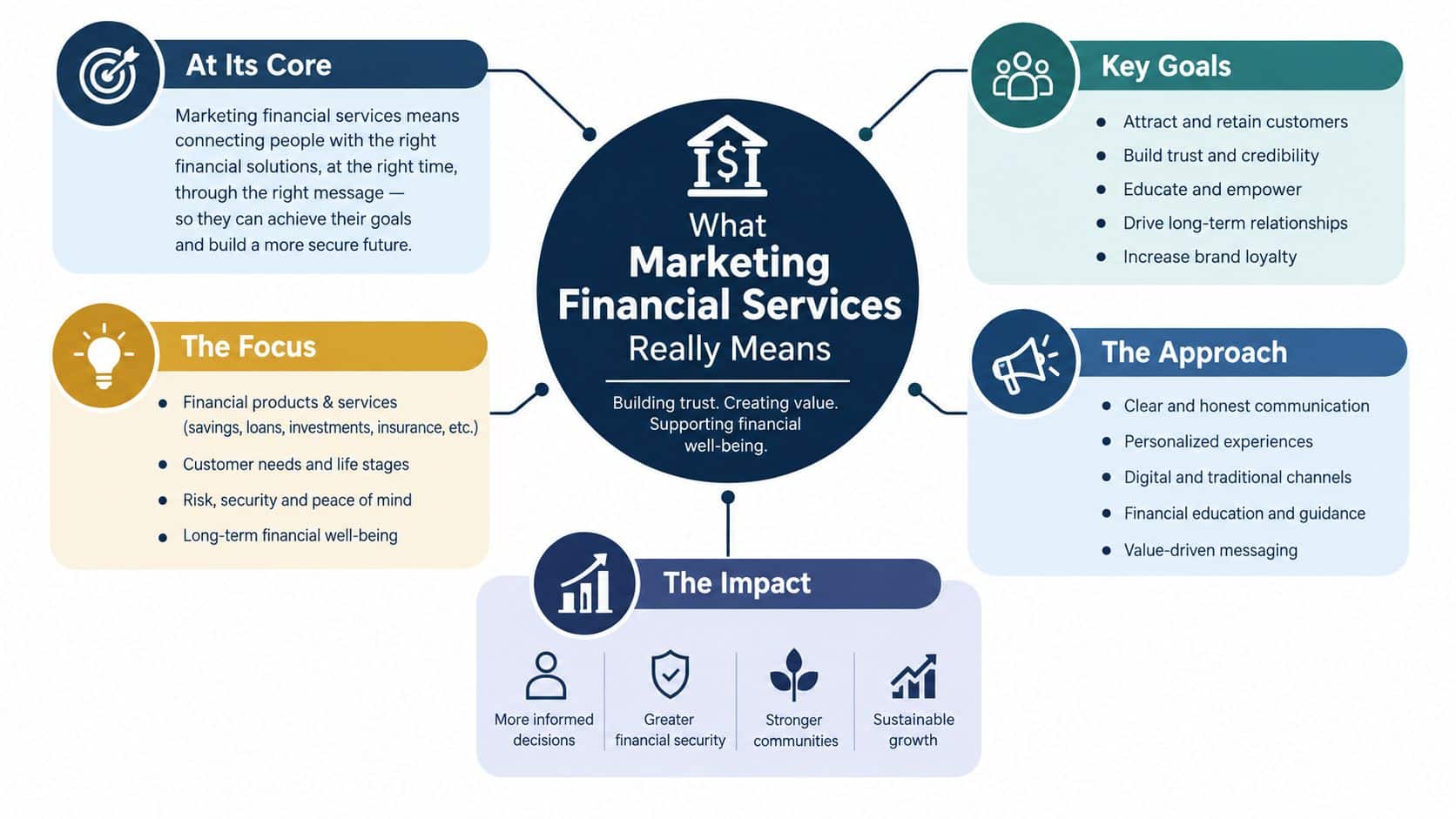
What Marketing Financial Services Really Means
A useful analogy is the difference between a trusted guide and a loud billboard. A billboard demands attention and makes a broad promise. A guide helps someone understand a difficult decision, explains the trade-offs, acknowledges uncertainty, and shows the next sensible action.
Financial marketing works more like the guide. A retirement planning article might explain the questions a household should bring to an initial meeting. A bank page might clarify how a lending process works without promising approval. A video might define a complex term in plain language. These assets create value before they ask for a booking, application, or account conversation.
The system behind the message
Marketing financial services combines four connected tasks:
- Positioning gives the firm a recognizable point of view. It answers who the firm serves, which problems it understands, and why its process deserves consideration.
- Education reduces confusion. It translates technical subjects into useful explanations without turning an article into individualized advice.
- Distribution places the explanation where a prospect is already looking, such as search, email, video, social media, or a referral environment.
- Conversion provides a clear next step, from downloading a guide to scheduling a consultation or beginning a banking conversation.
A common mistake is treating these tasks as separate projects. A new logo won't repair unclear content. Paid traffic won't fix a landing page that makes unsupported claims. AI personalization won't create trust if the underlying information is inaccurate or the firm can't explain how an audience segment was selected.
A financial prospect isn't only asking, “What does this firm sell?” They're also asking, “Can this firm explain the decision clearly, protect my interests, and communicate responsibly?”
That question makes credibility an operating requirement, not a decorative brand value. Teams that need a structured way to manage financial information and attribution can also review this attribution platform for finance teams as part of their broader documentation approach.
The funnel is best understood as a change in confidence. Early content helps a person recognize a problem. Mid-funnel resources help compare approaches and determine fit. A conversation gives the prospect a chance to evaluate people, process, and expectations. Each stage needs a different message, but every stage should reflect the same approved facts and brand standards.
Building a Compliant and Credible Brand Foundation
A strong financial brand makes the firm easier to recognize and easier to evaluate. The foundation includes the name, visual identity, tone, service descriptions, website structure, photography choices, disclosures, and internal approval process. If each asset presents a different promise, audience, or personality, prospects may interpret the inconsistency as operational uncertainty.
Brand consistency doesn't mean every page should sound identical. It means the firm should use stable definitions for its services, audience, credentials, investment philosophy, and calls to action. A brand guide can document approved terminology, prohibited shortcuts, visual rules, disclosure placement, and examples of plain-language explanations.

Design for confidence and review
A compliance-ready website should help a visitor understand:
- Who the firm serves: Define the audience with enough specificity to make the message meaningful.
- What the firm does: Explain services without implying outcomes that the firm can't substantiate.
- How the relationship works: Show the consultation, onboarding, or account process in understandable language.
- What the visitor can do next: Use a clear action that matches the prospect's level of readiness.
- Which disclosures apply: Place required information where a reasonable visitor can see and understand it.
A firm can reduce review friction by creating a source-of-truth library. Each approved claim should have an owner, supporting evidence, review date, permitted uses, and restrictions. Content authors then work from approved language instead of rewriting sensitive claims across multiple channels.
Advisors seeking a more detailed perspective on visual identity and positioning can review this financial services branding resource while building the firm's brand system.
Treat testimonials as regulated content
The SEC Marketing Rule became effective on May 4, 2021, with a compliance date of November 4, 2022. The SEC requires advisers to keep copies of advertisements they directly or indirectly disseminate, and performance presentations must follow rule-specific disclosure and books-and-records requirements, as explained in the SEC investment adviser marketing guide.
The rule also covers compensated testimonials and endorsements. The SEC says an advertisement must clearly and prominently disclose whether the promoter is a client and whether the promoter receives compensation, along with additional disclosures concerning compensation and conflicts where applicable, according to the SEC Marketing Rule announcement.
Promoter screening needs its own documented control. An adviser can't compensate someone for a testimonial or endorsement when the adviser knows, or should know with reasonable care, that the person had a disqualifying event within the prior 10 years before dissemination, as stated in SEC marketing compliance guidance.
For broker-dealers, retention rules also matter. FINRA Rule 2210 requires advertisements, sales literature, and independently prepared reprints to remain in a separate file from first use until three years after last use, with copies and dates of first and, where applicable, last use, according to the FINRA Rule 2210 text. A campaign is not audit-ready merely because the final PDF exists. The firm should be able to reconstruct who approved it, what version ran, where it appeared, and when it was withdrawn.
Choosing Digital Channels That Drive Qualified Leads
Channel selection should begin with intent, not fashion. Search captures an active question. Educational content builds discoverability over time. Paid social can introduce a firm to a defined audience, while programmatic display and video support recognition and repeated exposure. Each channel creates a different balance of control, cost, timing, and evidence.
Digital investment has already become substantial in financial services. One market report places U.S. financial services digital advertising spend at $28.4 billion in 2024, a 12.3% year-over-year increase, and says 47% of financial services companies allocate more than half of their marketing budgets to digital channels. The same financial services digital advertising report says programmatic advertising represents 84% of digital ad spend, mobile advertising reached $18.1 billion and 63.7% of total digital spend, and video advertising reached $5.2 billion in 2024 with 19% year-over-year growth.
A practical comparison
| Channel | Primary Intent | Cost Signal | Best Use Case |
|---|---|---|---|
| SEO | Information and problem discovery | Time and editorial resources | Building durable visibility around client questions |
| AEO and GEO | Direct answers and AI-assisted discovery | Content structure and governance effort | Making approved explanations easier to interpret and surface |
| Google Ads | Immediate, high-intent demand | Competitive click costs | Testing focused offers and capturing active searches |
| Programmatic display | Awareness and retargeting | Media spend and audience quality | Maintaining recognition across longer decision cycles |
| Paid social | Audience discovery and engagement | Media spend and creative production | Introducing educational ideas to defined audiences |
| Video | Explanation and human connection | Production and distribution resources | Making complex topics easier to understand |
Search behavior supports a search-first, mobile-first plan. A firm should build pages for questions prospects ask, then use paid search where the commercial intent justifies faster acquisition. Teams developing a broader business-to-business search framework can consult this SemDash B2B SEO guide for additional planning context.
The choice becomes clearer when each channel has a job. SEO can support foundational education, paid search can test demand for a specific consultation topic, and video can answer the objection that written content doesn't resolve. Programmatic and paid social should not be judged by lead volume alone if their role is earlier-stage trust and familiarity.
Avoid targeting too broadly. A generic audience may create inexpensive engagement but weak fit. A better campaign defines geography, service relevance, professional or life-stage context where permitted, exclusions, landing-page language, and the handoff process before launch.
Content Programs and AI Workflows That Stay Compliant
AI can help a financial marketing team draft variations, identify recurring questions, summarize approved source material, and tailor educational journeys. It shouldn't decide which claims are acceptable, invent supporting evidence, or publish directly to a client-facing channel without human oversight.
The safest workflow treats AI as a controlled production assistant. The approved source material remains authoritative, the model receives defined instructions, and a qualified reviewer evaluates the output for accuracy, fair presentation, tone, privacy, and regulatory requirements.

Build the workflow around evidence
A repeatable process can work like this:
- Content strategy: Select a client question, audience, business objective, and approved source material.
- Drafting and AI assistance: Generate a draft, outline, variation, transcript, or personalization suggestion using restricted inputs.
- Compliance review: Check factual support, required disclosures, performance language, testimonials, conflicts, privacy, and channel-specific rules.
- Publish and distribute: Release only the approved version, with a recorded location, date, audience, and owner.
- Monitor and adapt: Review engagement and lead quality, then revise through the same approval path.
The AI governance document should define permitted uses, prohibited inputs, reviewer responsibility, escalation triggers, version control, and retention. Personalization deserves special care. A message can be customized to a prospect's behavior without exposing sensitive information or implying knowledge the person didn't knowingly provide.
Turn one approved idea into many assets
An expert webinar, approved article, or educational video can become a blog article, social post, email explanation, and video script. Repurposing saves review effort only when every derivative remains traceable to the approved source. Editorial teams can document the source asset, generated drafts, human changes, final approval, distribution locations, and later revisions.
Teams establishing creating audit-proof compliance records can use that type of recordkeeping as a model for content operations. Advisors can also explore this financial services content marketing resource when planning an editorial program.
Independent outlook coverage identifies a practical gap in the current conversation. AI already affects marketing performance for 97% of financial marketers, while 73% of FinServ marketers are watching generative AI as a key consumer trend and 64% prioritize measurement and attribution, according to the 2026 financial services advertising outlook. Those figures point toward governance, not merely adoption. Trust-building content, educational podcasts, and third-party validation can support credibility, but each placement still needs ownership, disclosures where required, and a retrievable record.
Measuring Performance and Scaling Your Go to Market Engine
Measurement should connect marketing activity to the quality of the next business conversation. Clicks and impressions can show distribution, but they don't reveal whether the audience fits the firm, whether the landing page explains the offer, or whether staff can convert an inquiry into a productive consultation.
Financial services paid search carries meaningful acquisition pressure. Industry benchmark data reports a median Google Ads click-through rate of 2.91%, cost per click of $7.15, conversion rate of 5.10%, cost per acquisition of $81.93, and landing-page conversion rate of 5.01%, according to financial services digital acquisition benchmarks. These are benchmarks, not promises. They help teams understand why a small improvement in message clarity, page speed, form design, or audience fit can affect campaign economics.
Use a disciplined measurement loop
A useful dashboard separates four questions:
- Reach: Are the right people encountering the firm?
- Engagement: Do they read, watch, return, or complete a meaningful interaction?
- Conversion: Do they request a consultation, begin an application, or take another approved action?
- Quality: Does the inquiry match the firm's service, geography, capacity, and regulatory scope?
The landing page deserves its own review. The headline should match the ad or content that introduced it. The page should state who the service is for, explain what happens next, answer a likely concern, and use a proportionate form. A conversion is only useful when the receiving team has a defined response process and the prospect receives accurate expectations.
Scaling across states or service lines requires operational discipline. The firm should keep approved core language centralized, document local variations, route leads according to licensing and capacity, and review campaign changes before publication. Marketing and client service leaders should examine not only lead counts but also response time, appointment quality, show rates, onboarding progress, and recurring questions from prospects.
Optimization should happen one controlled change at a time where practical. A team might test a clearer headline, a shorter form, a different educational offer, or a more specific audience. The change, rationale, approval, launch date, and result should remain connected in the campaign record, so performance learning doesn't undermine compliance traceability.
Your Next Steps for Marketing Financial Services With Confidence
A firm doesn't need to rebuild every channel at once. It needs a sequence that protects trust while creating evidence about what works.
Start with an audit of the public experience. Review the website, search results, social profiles, advertisements, lead forms, automated emails, and follow-up scripts as a prospect would. Mark unclear promises, inconsistent service descriptions, missing ownership, outdated disclosures, and points where a qualified lead could stall.
Next, create a compact compliance and content library. Store approved descriptions, credentials, disclosure language, performance materials, testimonial records, audience definitions, and version histories in a location the marketing and compliance teams can use. Assign review responsibility before a campaign begins, rather than asking reviewers to reconstruct decisions after publication.
Then choose one audience and one problem. A retirement planning practice might focus on educational content for people preparing for an initial planning conversation. A bank team might focus on a clearly defined lending question. The campaign should use one primary landing page, one measurable action, a documented follow-up path, and a review process that covers every derivative asset.
Finally, connect marketing with operations. Advisors need a consistent way to respond to inquiries. Practice managers need capacity visibility. Compliance officers need records that can be retrieved without a last-minute search. Coaching and recruiting may also matter when lead volume grows faster than the firm's ability to serve new relationships.
The central principle is simple: personalization should make an approved message more relevant, not make an unreviewed claim more persuasive. Trust-building content should answer real questions, and every channel should lead into a process the firm can deliver consistently.
Advisor Momentum offers compliance-ready website development, branding, content programs, advertising across search and social channels, coaching, and recruiting support for financial advisors, planners, and banking professionals. Firms building an audit-ready approach to marketing financial services can visit Advisor Momentum to explore coordinated support from brand foundation through qualified lead generation.
