

Onboarding is both an operational control and the first proof of a firm's service promise. That's the surprising part: the fastest firms aren't necessarily cutting controls. They're designing the process so documentation, review, communication, and account setup move in a clear sequence. A 2026 benchmark found that top-performing firms responded within four hours of contract signature, completed onboarding in five days or fewer, and automated follow-ups, while bottom-tier firms had a median completion time of 23.7 days and often relied on manual email chains. The benchmark data links slow intake and manual chasing with materially worse early retention.
For RIAs, wealth managers, and bank teams, the challenge is practical. Teams must collect complete information, satisfy documentation and disclosure requirements, coordinate advisors, operations, compliance, custodians, and technology, and keep clients informed without creating unnecessary friction. A missing signature, unclear owner, or duplicated data request can delay the relationship and weaken confidence before the first review meeting.
The 10 client onboarding best practices below connect the full lifecycle, from workflow design and documentation through technology, communication, measurement, training, and change management. Some controls apply across nearly every regulated financial firm. Others require deliberate choices based on client segment, account complexity, service model, and review obligations. Advisor Momentum is also a relevant compliance-first resource for advisory and banking teams seeking support with onboarding workflows, coaching, or regulated communications, alongside broader guidance on financial services from Wisely.
Table of Contents
- 1. Establish a Standardized Onboarding Workflow
- 2. Implement Thorough Client Information Gathering
- 3. Develop Compliance-First Documentation and Procedures
- 4. Integrate Technology to Streamline and Automate
- 5. Create Clear Communication and Expectation Setting
- 6. Establish a New Client Welcome and Orientation Process
- 7. Personalize the Onboarding Experience by Client Segment
- 8. Assign Dedicated Onboarding Specialists or Teams
- 9. Create Measurable Onboarding Metrics and Goals
- 10. Build Ongoing Training and Quality Assurance Program
- Client Onboarding: 10-Point Best Practices Comparison
- Turn Onboarding Controls Into Client Confidence
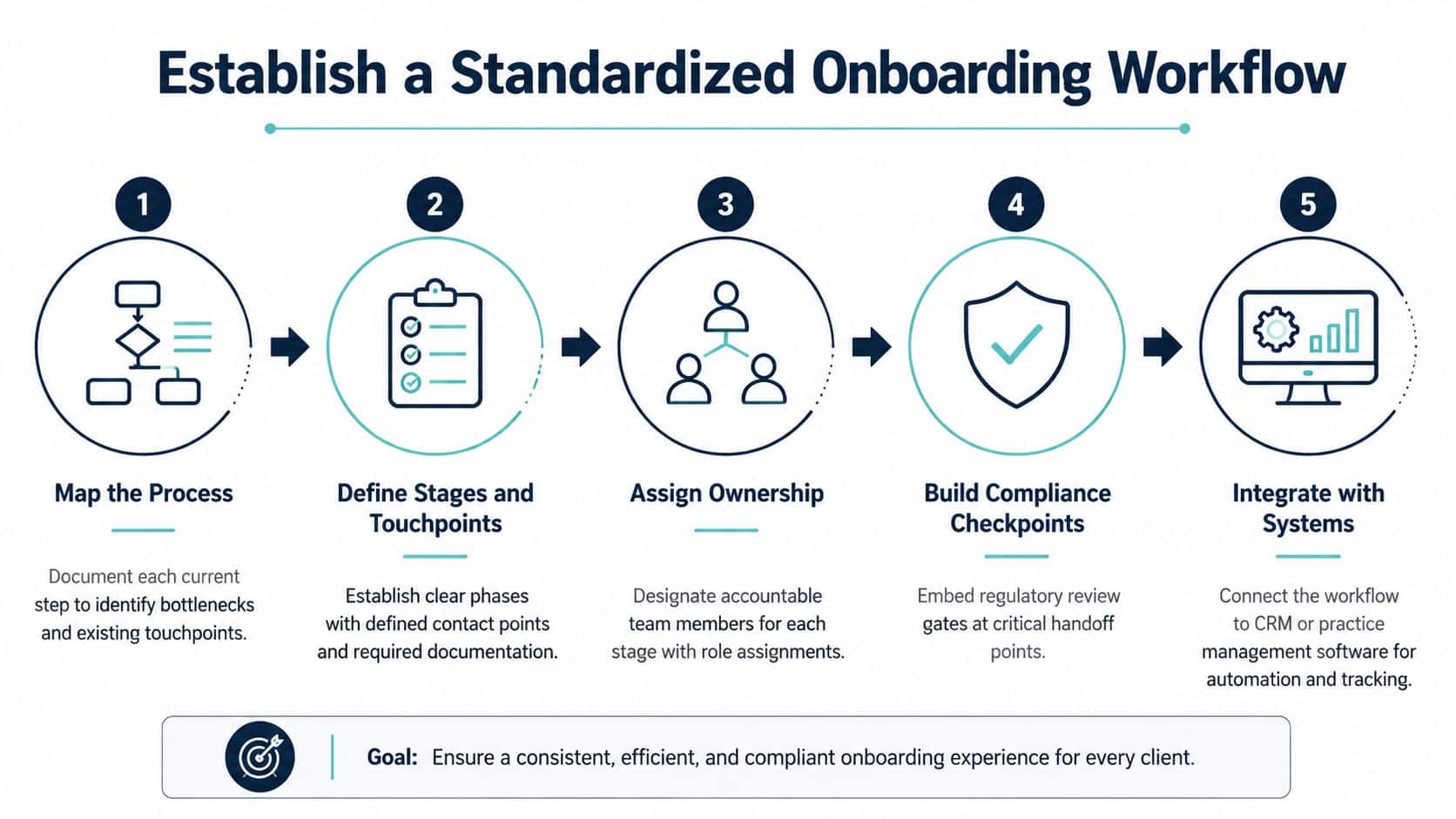
1. Establish a Standardized Onboarding Workflow
A standardized workflow gives every new client a dependable path from initial commitment to account setup and the first meaningful service interaction. It shouldn't turn advisors into script readers. It should make ownership, sequence, documentation, and escalation visible to everyone involved.
Start by mapping the current process exactly as it operates. Include the signed engagement, information request, identity verification, risk and suitability review, account opening, funding, disclosures, welcome contact, and first review. The map should show every handoff between the advisor, client service team, compliance, operations, custodian, and bank or practice-management systems. Bottlenecks usually appear where responsibility changes hands or where a person must chase information manually.
A firm can then create a documented workflow with stage definitions and completion criteria. A wealth management team using Salesforce or HubSpot might move a record from “engaged” to “information pending,” then to “compliance review,” “account setup,” and “active relationship.” An RIA could use separate routes for straightforward individual accounts and more complex trusts or business-owner relationships. A bank can sequence document collection through a document management system so required paperwork is reviewed in the intended order.
Put controls at the handoffs
A workflow is only useful if each stage has a clear owner and a defined exit condition. Practice-management software can route reminders, flag stalled tasks, and notify the next owner without relying on a long email chain.
Useful design rules include:
- Assign one accountable owner: Every stage needs a named person, even when several people contribute.
- Define compliance gates: Require review before recommendations, account opening, or activation when the firm's procedures call for it.
- Create stage checklists: Separate client tasks, advisor tasks, operations tasks, and compliance tasks.
- Review the workflow quarterly: Update procedures when regulations, custodial requirements, or systems change.
- Keep the client view simple: Show the next action, not the entire internal operating diagram.
Practical rule: A client should never have to determine which department owns the next step.
A process designed to reduce administrative work in coaching should still preserve human judgment at sensitive review points. Automation can route and remind, but it shouldn't approve suitability, resolve an identity concern, or replace a documented compliance decision.
2. Implement Thorough Client Information Gathering
Information gathering sets the quality of both advice and service. An advisor cannot make an appropriate recommendation from partial facts, while operations staff cannot open or maintain an account when required details are scattered across email attachments, notes, and spreadsheets.
Collect what the relationship requires, in an order clients can follow. A financial-advisor framework identifies early data such as government-issued photo ID, legal name, date of birth, Social Security number, residential address, risk tolerance, investment objectives, time horizon, annual income range, estimated net worth, recent account statements, and relevant tax-return pages. The advisor onboarding framework places e-signatures on advisory and custodial documents after the core information has been gathered.
Stage questions around client decisions
A long questionnaire can make a new client feel assigned homework. Short, sequenced requests work better for complex or regulated relationships. One financial-advisor guide recommends sessions across week 1 and week 2, collecting identification, risk tolerance, statements, beneficiary information, and signatures as each stage becomes relevant. The progressive onboarding guidance presents staged collection as a way to reduce abandonment while supporting KYC, AML, suitability, and disclosure obligations.
Build the intake around five information groups:
- Identity and contact details: Collect the information required to establish the client and communicate securely.
- Financial profile: Request assets, liabilities, income, statements, tax context, and ownership details relevant to the engagement.
- Objectives and constraints: Capture goals, time horizon, liquidity needs, risk tolerance, and restrictions.
- Review and signatures: Present agreements, disclosures, and forms after explaining what the firm needs and why.
- System reuse: Send verified information into the CRM, servicing records, and risk systems instead of requesting it again.
Conditional logic should display only questions relevant to the client's circumstances. A trust, retirement account, individual household, and business-owner relationship should not receive identical forms. The trade-off is deliberate: custom forms require more setup, but they reduce irrelevant questions, incomplete responses, and follow-up work.
Explain sensitive requests beside the question. Clients are more likely to provide accurate information when they understand its connection to identity verification, suitability, account administration, or ongoing service. A secure intake process should also connect collected information with the firm's client relationship management approach for financial services, so verified details remain useful after the account opens.

3. Develop Compliance-First Documentation and Procedures
Compliance belongs in the workflow from its first design, not at the final review. Define the evidence required, the decisions to record, and the approvals to retain before staff promise a completion date. This approach turns control points into predictable steps that reduce surprise requests for clients.
Create one controlled record for every agreement, disclosure, investment objective, risk assessment, suitability determination, identity record, and client communication. Approved templates should carry version control, while electronic signatures should preserve a complete audit trail. Document management systems can restrict access, retain prior versions, and prevent staff from sending outdated forms.
Separate the reviews that serve different purposes. Identity verification, KYC and AML checks, suitability analysis, account-opening requirements, and marketing or communication review may require different owners and evidence. A single “compliance complete” status hides gaps. Use distinct statuses and escalation rules so staff can see which checkpoint remains open.
Build an evidence map, not a paperwork pile
A stage-level documentation matrix gives each requirement four clear fields: required item, responsible owner, review standard, and storage location. Add the response for incomplete, inconsistent, expired, or escalated information. Supervisors can then test the process against actual files instead of relying on informal knowledge.
Financial institutions are increasingly using digital-first verification, electronic forms for additional documentation, and ongoing monitoring through perpetual KYC. Moody's guidance on financial-institution onboarding describes perpetual KYC as continuous management of changing risk factors rather than relying only on periodic refresh cycles. For regulated teams, this connects onboarding with the continuing relationship and gives clients a clearer reason for later information requests.
Build these safeguards into operating procedures:
- Approved templates: Maintain current agreements, disclosures, and questionnaires.
- Electronic audit trails: Record who signed, reviewed, changed, or approved each document.
- Exception handling: Set escalation paths for missing, conflicting, or unusual information.
- Pre-exam reviews: Test representative files before a regulatory exam exposes a gap.
- Role-based access: Limit information to what each employee needs for assigned responsibilities.
Quarterly onboarding audits can expose recurring process weaknesses. Annual training should explain both the rule and its purpose, so employees apply controls consistently and communicate them clearly. Track findings through remediation, then update procedures when the workflow, systems, or regulations change. Clear checkpoints give compliance, operations, and client-facing teams the same definition of readiness, reducing delays without weakening oversight.

4. Integrate Technology to Streamline and Automate
Technology should shorten repetitive coordination while keeping accountability with the firm. A CRM can show relationship status, a practice-management system can route tasks, a document platform can control records, and an e-signature tool can reduce printing and scanning. The client benefits when approved systems share status and verified data instead of requiring staff to repeat the same updates.
Start with the workflow, not the software. Document each required stage, identify manual handoffs, and mark where judgment or compliance review is required. Then assess integration, permissions, auditability, data retention, and usability. A cheaper system that creates duplicate entry may cost more in staff time and correction work.
Use automation for events with clear rules:
- Task creation: Open the next internal task after a client submits a completed form.
- Reminder delivery: Send secure reminders when a required document remains outstanding.
- Status visibility: Show whether the case is waiting for the client, advisor, operations, custodian, or compliance.
- Data transfer: Reuse verified fields across approved systems, with a review before downstream submission.
- Exception alerts: Notify a designated employee when information conflicts or a rule fails.
A practical design separates straight-through processing from decisions that require human judgment. Routine completeness checks can reduce waiting time. Identity, suitability, unusual ownership, and conflicting information still need a controlled review path. In that model, compliance checkpoints explain the next action and prevent clients from receiving avoidable repeat requests.
Technology introduces risks of its own. A poorly configured integration can duplicate records, expose sensitive information, or move an incomplete field into another system. Require access controls, test cases, documented system ownership, and an assigned technology lead. Training should cover both the button sequence and the reason for each review, so staff can handle exceptions rather than work around the system.
For teams assessing client engagement software for financial professionals, evaluate whether the platform makes the next action clear, preserves evidence, supports approved controls, and reduces client effort. Feature volume matters less than reliable handoffs, visible ownership, and a process the team can maintain after implementation.
5. Create Clear Communication and Expectation Setting
Clear communication is a control, not a courtesy. Clients become frustrated when a regulated firm requests information without explaining why, changes the sequence without warning, or stops communicating after receiving a signed engagement.
Start with a concise onboarding roadmap. State what happens first, which information the client must provide, how secure channels will be used, when the team normally responds, and what the client receives at each milestone. Use language a household or business owner can understand, while keeping the underlying process precise enough for operations and compliance teams.
Match the format to the relationship. A financial planning firm might provide a short welcome video explaining the planning process and anticipated meetings. A wealth manager might show portfolio setup, tax-planning work, and planning conversations on a visual timeline. An RIA can send an automated receipt for submitted documents, then assign a person to explain any next step requiring judgment.
Give every message a clear job
A signed engagement should start a defined communication sequence. One advisor guide recommends sending the signed engagement letter and welcome email within 24 hours, followed by a digital packet, KYC, AML, suitability, and risk-profile forms, custodial e-forms, and scheduling for the first quarterly review and recurring service reminders. The recommended financial-advisor sequence offers a practical order without forcing every client into the same script.
Each message should answer three questions:
- What has happened: Confirm the form, document, or review the firm completed.
- What happens next: Name the next action and its owner.
- What the client should do: Specify the required action, secure location, and expected timing.
Assign one primary contact for the relationship. Advisors, assistants, custodians, and compliance staff may each have a role, but clients should not receive conflicting instructions. Templates can include the client's name, relationship type, and current milestone. Avoid promising dates that depend on external review or incomplete information.
Silence also creates operational risk. Send a brief update when a file is waiting for a custodian, additional documentation, or internal approval. Explain what remains pending, who owns the next decision, and whether the client needs to act. Even a status message that confirms no new action is required helps preserve confidence while compliance checks continue.
6. Establish a New Client Welcome and Orientation Process
A welcome process should make the firm's operating model understandable before the first formal review. Clients need to know who supports them, how decisions are made, which channels are secure, and what service they can expect. That orientation turns completed paperwork into a working relationship.
Choose a format the team can deliver consistently. It may combine a call, planning meeting, short video, written guide, or introduction to key staff. A local practice could offer an office tour, while a distributed advisory team could provide a recorded introduction and secure-portal walkthrough. Keep the first contact focused. Too much policy, technical detail, or service information can obscure the actions that matter now.
Make orientation a controlled handoff
Use the welcome meeting to confirm the engagement scope, immediate priorities, communication preferences, decision-makers, authorization limits, and special needs. Separate urgent matters from topics reserved for the first planning or portfolio review. This distinction helps staff respond quickly without turning the meeting into another full data-gathering session.
Give the client a concise orientation guide covering:
- Team responsibilities: Identify the advisor, service associate, operations contact, and escalation path.
- Service calendar: Show planned meetings, reporting rhythms, and review points.
- Secure communication guidance: State where sensitive documents and questions belong.
- Decision expectations: Clarify what the client approves, what the firm handles, and where review may delay an action.
- Immediate concerns: Ask about a transfer, liquidity need, family circumstance, or deadline requiring attention.
Assign an owner to each follow-up item and record the outcome in the client file. This connects the welcome conversation to workflow, documentation, and later quality checks. A central location for documents and communications also prevents clients from shifting among mailed, emailed, and in-person materials. Capital Group's guidance on repeatable advisor onboarding describes centralization as a way to create a more consistent experience and support future referrals.
Compliance should be visible and explained in plain language. A secure portal, clear identity-verification explanation, and transparent review step show that safeguards protect the relationship. They also give clients a reason for each checkpoint, reducing confusion while the firm completes required checks.
7. Personalize the Onboarding Experience by Client Segment
Personalization should change the client's path, explanation, or support level. It should not create a bespoke workflow that staff cannot deliver consistently.
Start with documented segmentation criteria: account complexity, ownership structure, service model, client sophistication, transfer requirements, and the internal teams involved. Possible segments include retail clients, high-net-worth households, institutional relationships, business owners, trusts, retirement accounts, and transfers from another advisor. Record the criteria in the workflow so employees classify similar relationships consistently.
Design controlled variations
A complex business or financial-services client may want expert recommendations instead of an open-ended customization exercise. Recent onboarding trend coverage describes this tension for mid-market and enterprise relationships. In regulated advisory or banking settings, excessive customization can delay review, produce inconsistent handling, and increase compliance risk. A generic process can weaken trust.
Use a common control framework, then vary the experience around it:
- Standardize the core: Apply identity, risk, suitability, disclosure, security, and recordkeeping controls to every segment.
- Explain sensitive requests: Tell clients why information is required and how it supports account setup or ongoing service.
- Vary support levels: Provide more live guidance when complexity or vulnerability requires it.
- Limit optional choices: Adjust the communication format or meeting agenda only when doing so improves clarity.
- Reuse verified data: Prevent duplicate fields and repeated requests for information already recorded.

A high-touch household may need coordinated meetings and a dedicated relationship contact. A straightforward account may use digital forms with limited advisor involvement. A business owner may require questions about ownership, liquidity events, tax coordination, and succession priorities. These changes affect sequencing and support, not the firm's underlying compliance controls.
Review the segment during onboarding and at later service points. If circumstances, assets, ownership, or service needs change, staff should move the relationship to another workflow without restarting intake. Record the reason for the change so advisors, operations, and compliance can see which requirements still apply. This keeps personalization connected to documentation, technology, communication, measurement, and change management rather than treating it as a one-time preference.
8. Assign Dedicated Onboarding Specialists or Teams
Assign one person or a small team to keep each onboarding case moving. Clear ownership builds process knowledge, gives clients a consistent contact, and leaves advisors more time for relationship building and financial planning.
The role can start part time. A growing RIA might assign an operations professional to coordinate cases, then expand the position as volume rises. A wealth management firm could create a junior-advisor onboarding track covering systems, documentation, client communication, and escalation. A practice may also use outside support for document processing or data entry, provided it addresses access controls, confidentiality, supervision, and recordkeeping requirements.
The specialist coordinates the workflow rather than making every decision. Advisors retain responsibility for advice and relationship judgment. Compliance retains authority over required reviews, while operations manages account-opening execution. The specialist connects these responsibilities, confirms the next action, and keeps the client informed about approved steps.
Define ownership, authority, and coverage
Give the role a written charter with clear boundaries:
- Case ownership: Maintain the active checklist, current status, and required handoffs.
- Client communication: Send approved updates and explain routine next steps in plain language.
- Escalation: Route suitability questions, identity concerns, exceptions, and service issues to the appropriate decision-maker.
- Data quality: Check required fields for completeness and consistency before handoff.
- Reporting: Identify aging cases, stalled tasks, and recurring failure points for process review.
- Coverage: Maintain backup capacity so onboarding continues during leave or staff turnover.
The specialist needs training in compliance procedures, system permissions, secure communication, service standards, and the limits of their authority. Job shadowing supports continuity. Documented escalation rules prevent improvisation when an issue requires advisor or compliance judgment.
Compliance checkpoints can improve the client experience when the specialist explains what is required, why it is needed, and what happens next. That clarity reduces repeated requests and gives advisors, operations, and compliance a shared view of the case.
A dedicated team can also create another silo. Use the structure only when the specialist has workflow visibility, access to decision-makers, and responsibility for resolving stalled handoffs. Review workload, exception patterns, and client feedback as the process changes, then adjust staffing or authority before delays become routine.
9. Create Measurable Onboarding Metrics and Goals
A useful onboarding metric connects operational speed with client readiness and control quality. Completion alone can mislead. A file may be marked complete while the client still lacks clarity, the account remains unfunded, or staff have bypassed review to meet a target.
Define the measurement before collecting data. Choose one value event, one activation window, and a stable denominator so results remain comparable from month to month. For a regulated financial firm, the value event might be a completed discovery and risk profile, an approved account-opening package, a funded account, or a scheduled first review. Select the event that matches the firm's service promise and compliance requirements.
A 2026 benchmark report suggests a 7-day window for PLG self-serve, 14 days for B2B SaaS, and 30 days only for long deployments. The benchmark's activation guidance reports median activation rates of 38% for B2B SaaS, 44% for fintech, and 29% for B2B services, with time-to-value varying by contract size. These categories do not directly represent advisory onboarding. Their measurement principle still applies: define the event before interpreting the result.
Set targets that expose delay without encouraging shortcuts.
A dashboard can combine the following measures:
- First-response time: Records how quickly the firm acknowledges the signed relationship.
- Completion time: Shows where the workflow slows while preserving required review.
- Documentation completeness: Distinguishes properly completed files from cases closed on appearance.
- Client experience: Captures clarity, confidence, and perceived effort.
- Exception aging: Shows which cases require management attention.
Segment the results by account complexity, client type, and external dependency. A single completion clock can make a high-touch account look like a process failure when the delay reflects required suitability analysis or missing information from a third party.
The same report records median time-to-value of 11 minutes for accounts under $5K ARR, 2.4 days for $5K-$25K, 9 days for $25K-$100K, and 23 days for $100K+. Those figures describe other business categories and should not become artificial advisor quotas. They demonstrate why interpretation must reflect the work involved.
A separate 2026 benchmark recommends first response under six hours, completion under seven days, and a day-30 satisfaction score of 9.1 out of 10 among the top 20% of firms. The benchmark recommendations can inform internal goals, but leaders should adjust them for account complexity and external dependencies. Review the measures with operations, advisors, and compliance so targets reinforce accurate documentation, timely communication, and a clear client experience rather than speed alone.
10. Build Ongoing Training and Quality Assurance Program
Training and quality assurance keep the documented onboarding workflow connected to daily behavior. Without regular reinforcement, new employees learn through observation, experienced staff interpret controls differently, and system changes leave procedures out of date.
Set role-based training requirements for everyone involved in onboarding. Each person should know the workflow, decision authority, compliance checkpoints, approved communication channels, and client-service standard. Training materials should cover the workflow map, stage checklists, sample messages, escalation scenarios, system instructions, and the purpose of each control. Explaining the purpose helps staff apply a checkpoint correctly when a case does not follow the usual path.
Use case reviews to improve the process
Quality assurance should examine real onboarding files, including completed, stalled, and exception cases. Reviewers can verify that required information was collected, signatures and disclosures were complete, risk and suitability records supported the recommendation, documents were stored correctly, and client updates were sent at agreed milestones.
Use a review cycle that produces assigned actions:
- Case reviews: Identify recurring issues across completed and delayed files.
- Peer review: Have an experienced advisor or operations lead examine complex cases.
- Targeted audits: Focus on recurring defects, revised procedures, or higher-risk client segments.
- Team learning: Discuss findings without treating every error as individual misconduct.
- Change logs: Record what changed, why, who approved it, and when training occurred.
- Adoption checks: Confirm that staff follow the revised workflow in the system and in written guidance.
Assign ownership for change management. If a custodian changes a form, a regulator updates an expectation, or the firm introduces a new CRM integration, leaders should identify affected roles, revise procedures, train staff, test the change, and monitor early cases. Compliance review can then function as a client-experience control: clear requirements reduce repeated requests, unexplained delays, and inconsistent answers.
Quality assurance should ask two questions: Did the firm meet its control requirements, and did the client understand what happened?
That test separates paperwork completion from effective onboarding. It also helps leaders identify whether a failure came from training, workflow design, system configuration, or an unrealistic service promise. Review findings should feed back into documentation, technology settings, client communications, and future training, so the onboarding lifecycle improves as conditions change.
Client Onboarding: 10-Point Best Practices Comparison
| Initiative | Implementation Complexity 🔄 | Resource Requirements ⚡ | Expected Outcomes 📊 | Ideal Use Cases | Key Advantages ⭐ | Quick Tip 💡 |
|---|---|---|---|---|---|---|
| Establish a Standardized Onboarding Workflow | Medium, map & document sequential stages 🔄🔄 | Moderate, process mapping + some system integration ⚡⚡ | Consistent client experience; fewer errors; measurable process metrics 📊 | Firms scaling or with multi-advisor teams | Consistency, compliance alignment, scalable training ⭐ | Map current state first; automate reminders |
| Implement Comprehensive Client Information Gathering | Medium, design forms & validation logic 🔄🔄 | Low–Moderate, digital forms, eSign integrations ⚡⚡ | Faster account setup; complete data for suitability & audits 📊 | Advisory firms needing full financial profiles | Better recommendations; reduced back-and-forth ⭐ | Use conditional logic; break into sections |
| Develop Compliance-First Documentation and Procedures | High, legal templates, checkpoints, audits 🔄🔄🔄 | High, compliance expertise, DMS, ongoing updates ⚡⚡⚡ | Lower regulatory risk; streamlined audit readiness 📊 | Firms under heavy regulatory oversight (RIAs, banks) | Risk reduction; strong audit trail; client trust ⭐ | Consult compliance counsel; embed gates early |
| Integrate Technology to Streamline and Automate | Medium–High, integrations and configuration 🔄🔄🔄 | High, software licenses, IT support, training ⚡⚡⚡ | Faster onboarding; fewer manual errors; visibility into status 📊 | Growing firms seeking efficiency and scale | Automation of repetitive tasks; improved productivity ⭐ | Map process before selecting tools; assign tech champion |
| Create Clear Communication and Expectation Setting | Low, templates and defined cadence 🔄 | Low, communications, simple automation ⚡ | Increased client confidence; fewer support inquiries 📊 | All client-facing firms; relationship transfers | Builds trust; reduces client anxiety ⭐ | Send visual timelines; contact client within 24 hrs |
| Establish a New Client Welcome and Orientation Process | Low–Medium, scheduling & materials setup 🔄🔄 | Low, advisor time, welcome materials ⚡⚡ | Faster relationship building; clearer service expectations 📊 | Firms prioritizing client experience & retention | Strong first impression; early issue identification ⭐ | Schedule welcome meeting in first week; use agenda |
| Personalize the Onboarding Experience by Client Segment | High, multiple tiered workflows to manage 🔄🔄🔄 | Moderate–High, segmentation rules, tailored resources ⚡⚡⚡ | Higher satisfaction; optimized resource allocation 📊 | Firms with distinct client tiers (HNW, retail, institutional) | Tailored service; cost efficiency; better retention ⭐ | Define clear segmentation criteria and test pilots |
| Assign Dedicated Onboarding Specialists or Teams | Medium, role design, training, escalation paths 🔄🔄 | High, staffing, training, backup coverage ⚡⚡⚡ | Consistent onboarding; advisors free for advisory work 📊 | Scaling firms moving beyond founder-led models | Process ownership; faster, more consistent onboarding ⭐ | Start part-time specialist; track KPIs to scale role |
| Create Measurable Onboarding Metrics and Goals | Medium, define KPIs, dashboards, baselining 🔄🔄 | Low–Moderate, reporting tools and review time ⚡⚡ | Identifies bottlenecks; supports continuous improvement 📊 | Firms wanting data-driven process optimization | Accountability; justifies investments; forecasts capacity ⭐ | Start with 3–5 KPIs; review monthly |
| Build Ongoing Training and Quality Assurance Program | Medium–High, training curriculum & QA loops 🔄🔄🔄 | Moderate, leadership time, training materials, audits ⚡⚡ | Fewer compliance issues; consistent service quality 📊 | Firms seeking consistent standards and growth | Institutional knowledge; continuous improvement culture ⭐ | Assign a training owner; run regular case reviews |
Turn Onboarding Controls Into Client Confidence
The strongest onboarding programs don't choose between speed and control. They design control points that are visible, sequenced, and easy for both staff and clients to follow. A secure identity check, a suitability questionnaire, a disclosure, or a compliance review can improve the experience when the firm explains the purpose, collects information at the right stage, and avoids asking for the same evidence repeatedly.
Implementation should begin with the current state, not a software demo. Document the workflow from signed engagement through account setup and the first review. Record every handoff, duplicate request, manual reminder, exception, and approval. This creates a factual baseline and exposes where clients wait without knowing why.
Next, identify the control and handoff gaps. Separate missing documentation from unclear ownership, system limitations, client confusion, and external dependencies. A firm may discover that its longest delays don't come from compliance review at all. They may come from an incomplete intake form, a lost email attachment, or a case that no employee formally owns.
Choose a small KPI set before changing the process. First-response time, completion time, documentation completeness, exception aging, and client satisfaction can provide a balanced view. Leaders should define the value event, activation window, denominator, owner, and review schedule. Speed metrics should never encourage staff to close a case before the file is complete or appropriate review has occurred.
Communication deserves an early improvement because it often produces visible gains without a major technology project. Send a clear welcome message after engagement, explain the secure intake process, show the next milestone, and provide proactive updates when another party controls the timeline. A portal can replace scattered attachments, but the firm still needs a human contact for sensitive questions and exceptions.
A pilot should involve one client segment before the firm expands the workflow. A straightforward individual relationship may reveal different issues than a trust, institutional account, business owner, or transfer from another advisor. Use the pilot to test the forms, permissions, automation, staff responsibilities, escalation paths, and client messages. Then revise the process based on observed cases rather than assumptions.
Leaders should assign one person responsibility for onboarding performance and quality assurance, while preserving advisor and compliance authority where judgment is required. Training should accompany every significant process or technology change. Managers should review results regularly, discuss audit findings constructively, and update procedures as systems, custodial requirements, and regulatory expectations evolve.
Advisor Momentum may be relevant for firms that need compliance-first coaching and operational support for financial advisors, planners, and banking professionals. Its stated services include training and development around new client onboarding and existing client workflows, with attention to regulated execution. The right external support should complement, not replace, internal ownership and documented controls.
The practical standard is straightforward. Clients should know what the firm needs, why it needs it, what happens next, and who is responsible. Staff should have one reliable workflow, one source of status, and clear escalation rules. Compliance teams should be able to find the evidence behind each decision. When those conditions work together, onboarding becomes more than account setup. It becomes the first dependable demonstration that the firm can protect the client, communicate clearly, and deliver the service it promised.
Advisor Momentum provides compliance-first coaching, workflow support, regulated content, and operational guidance for financial advisors, planners, and banking professionals. Firms looking to strengthen client onboarding, improve communication, and align growth with compliant execution can visit Advisor Momentum to explore the available services.
