

A prospect signs the engagement letter at 4:47 p.m. on a Thursday. The advisor feels the momentum. The client feels relief. Everyone assumes the hard part is done.
Then the firm goes quiet for five days.
That's where many advisory relationships start to wobble. The documents may be compliant, but the experience feels disjointed: a welcome packet arrives late, a buried email asks for identity documents, and the first real conversation about what happens next gets pushed far enough out that confidence starts leaking.
A strong financial advisor client onboarding process doesn't treat onboarding as paperwork. It treats onboarding as the client's first 30 to 90 days of the relationship. That window includes intake, disclosures, account setup, funding, and the first review. It also includes something many firms miss: clear handoffs between advisor, operations, and compliance so the client never has to guess who owns the next step.
Table of Contents
- What a Modern Financial Advisor Client Onboarding Process Actually Looks Like
- Setting Up the Intake Workflow Before the First Meeting
- Running KYC, AML, Suitability, and Disclosure Checks in the Right Order
- Choosing Between Paper, Hybrid, and Fully Digital Intake
- Communication Templates That Carry the Client From Signature to First Review
- Onboarding Complex Households and Entity Clients Without Losing the Timeline
- Measuring Whether Your Onboarding Process Is Actually Working
What a Modern Financial Advisor Client Onboarding Process Actually Looks Like
The signed agreement is not the finish line. It's the moment the client starts watching whether the firm operates the way it promised during discovery.
In many firms, the first month still runs like a relay with no baton handoff. The advisor closes the engagement. Operations waits for notes. Compliance waits for forms. The client gets three separate requests from three different people and starts wondering whether the relationship will feel this fragmented all the time.
A modern onboarding flow fixes that by treating the first month as one coordinated experience.

The three phases that matter
Most firms need three clear phases.
Pre-engagement intake
The firm confirms fit, scope, household structure, and basic data before the formal paperwork starts.Compliance and account opening
This phase handles identity checks, disclosures, agreements, custodial forms, and transfer instructions in a controlled order.Handoff to the ongoing service team
The relationship either strengthens or stalls. The client needs a scheduled touchpoint, a named contact, and a clear view of what happens between account opening and the first review.
Where firms usually lose momentum
The most fragile point is the gap between signature and the first scheduled touchpoint. If no one owns that window, the client experiences silence followed by document chasing.
Most onboarding problems don't come from one big failure. They come from small delays that make the client feel uncertain.
That's why operational choreography matters. The advisor should set expectations and frame the relationship. Operations should manage collection, status tracking, and custodial coordination. Compliance should verify that disclosures, recordkeeping, and required checks happened in the right sequence. When those roles blur, rework climbs.
The same principle shows up outside wealth management. A strong new hire onboarding checklist works because it turns a handoff into a managed experience instead of a pile of tasks. Advisory onboarding works the same way.
What the client should feel by Day 30
By the end of the first month, the client shouldn't just know that forms were signed. The client should know:
- Who to contact for each question
- What's complete and what's still in motion
- When the first review happens
- Why each request matters
If the client reaches Day 30 with funded accounts, clear next steps, and confidence in the team, the process is working. If the client reaches Day 30 with confusion, duplicate requests, and no meaningful conversation since signing, the firm has an operations problem, not a client problem.
Setting Up the Intake Workflow Before the First Meeting
The intake workflow should start before discovery, not after it. When firms wait until the first meeting to figure out scope, conflicts, privacy handling, and document collection, they create rework that follows the file all the way through funding.
What needs to happen before discovery
Before the meeting is even scheduled, the firm should lock down three decisions.
Scope of service
The advisor should know whether the prospect is entering a planning relationship, investment relationship, or a combined engagement.Conflicts check
This check should happen before sensitive data starts moving through the firm.Preliminary data room
A secure intake channel should already exist so statements and personal information don't get scattered across inboxes.
At scheduling, send the calendar hold and a short prep email. Keep it tight. Ask for prior statements, current beneficiary language, employer plan details, and entity formation documents when applicable. A short prep list gets better response than a giant checklist dropped on the client without context.
The intake sequence that prevents leakage
The sequence should move in a straight line.
First, the advisor confirms fit and meeting purpose. Next, the firm opens the secure intake path and tracks initial document requests. After the discovery meeting, operations should trigger the formal engagement letter, privacy notice, and disclosure delivery package within 24 hours.
For retail-facing advisory or brokerage relationships, Form CRS is mandatory, and filing depends on registration status: advisers file through IARD, broker-dealers through Web CRD, and dual registrants may use both systems when the relationship summary must be delivered to retail investor clients or customers of both businesses, as laid out in the SEC's Form CRS instructions.
Practical rule: If the client has to ask, “Did you get my documents?” the workflow is underbuilt.
The checkpoints that keep the file moving
Three checkpoints prevent drift better than long task lists:
CRM stage movement
Every stage change should reflect an actual event, not a guess that someone is “working on it.”Document tracking link
One shared view of outstanding items prevents duplicate outreach.Operations acknowledgement within 48 hours
Once the client sends materials, operations should confirm receipt fast. Silence after document submission is where trust starts slipping.
A workflow automation layer helps here because it reduces missed handoffs and stale tasks. Firms that need to tighten this part of the process often start by mapping status triggers and ownership, then automate only the steps that repeat cleanly. Advisor teams that want a practical framework can study workflow automation for advisory processes.
The timing target that changes behavior
The intake standard should be simple: discovery to signed engagement in 5 business days, not 5 weeks.
That target forces better prep, faster recap delivery, and less meandering between meetings. It also protects client momentum. A prospect who is ready to move rarely becomes more decisive after a long, vague intake cycle.
Running KYC, AML, Suitability, and Disclosure Checks in the Right Order
The cleanest onboarding files come from one discipline: run compliance in the right order. Most rework in advisory onboarding happens because firms let suitability conversations and account forms race ahead of identity verification.
That feels productive in the moment. It usually creates duplicate data entry, stale signatures, and messy audit trails later.
The order that reduces rework
A practical sequencing model puts KYC and AML first, then suitability and risk profiling, then account-opening and transfer documents. That order reduces rework because identity, objectives, time horizon, income and net worth, and beneficiary data are gathered before advisory agreements and custodial forms are finalized, with industry guidance also pointing to targets of collecting more than 80% of required documents within 7 days, fully funding accounts in under 21 days, and maintaining 12-month retention above 95% in a disciplined onboarding design, as outlined in this advisor onboarding workflow guidance.
The sequence should look like this:
| Compliance Step | Owning Role | Typical Cycle Time |
|---|---|---|
| Identity verification for all owners and controllers | Advisor collects, operations verifies | Early in the file |
| Beneficial ownership review for entities | Advisor collects, operations verifies | Early in the file |
| Sanctions and PEP screening | Compliance oversight with operations support | After identity intake |
| AML risk scoring | Compliance | After screening review |
| Suitability and risk profile documentation | Advisor with operations support | After identity is confirmed |
| Disclosure delivery and acknowledgements | Advisor delivers, operations records, compliance reviews | With engagement package |
| Custodial execution | Custodian after internal clearance | Final execution stage |
Why identity has to come first
The SEC and FinCEN proposed a customer identification program for RIAs and ERAs that would require procedures to verify each customer's identity to the extent reasonable and practicable and maintain records of the information used for that verification, making identity documentation a defined onboarding step rather than an informal best practice, according to the SEC release on the proposed customer identification program.
That matters operationally. If identity flags an issue late, the firm has to revise records, resend documents, and sometimes re-paper the file. Running suitability first may feel client-friendly, but it creates expensive rework when a basic KYC issue surfaces afterward.
Teams that are trying to streamline identity verification usually get the most benefit when they pair process discipline with better intake prompts, not when they add another checkpoint.
Disclosure delivery and recordkeeping
For retail relationships, disclosures belong alongside the engagement package, not as an afterthought. That means Form CRS, ADV Part 2A where applicable, and any state-required disclosures should go out in the same controlled communication flow with timestamped acknowledgements.
SEC staff guidance is especially clear on recordkeeping. Broker-dealers must record the date each Form CRS was provided to each retail investor, including versions delivered before an account is opened, and there is no exception even if the prospect never opens an account, as stated in the SEC Form CRS FAQ.
Timeline standards by client type
A disciplined team can usually clear the compliance package in 7 to 10 business days for individuals and 15 to 20 business days for entities when ownership is clear, documents arrive on time, and no exceptions surface.
The file should move because the sequence is right, not because staff members are chasing the same problem from three directions.
Track rework by exception type. Missing IDs, outdated entity documents, and mismatched names are not random problems. They usually point to a broken collection order or weak intake instructions.
Choosing Between Paper, Hybrid, and Fully Digital Intake
Most firms don't need a perfect intake model. They need one they can operate consistently without creating confusion for clients or chaos for staff.
Paper, hybrid, and fully digital intake can all work. The right choice depends less on fashion and more on complexity, client preference, and how disciplined the firm is about data capture.
What the trade-off really is
Paper-first feels familiar to some clients and some senior staff. It also creates the most handoffs, the most scanning, and the most opportunities for stale versions.
Hybrid intake usually gives mid-sized RIAs the best balance. Agreements can be signed electronically, supporting documents can be uploaded securely, and staff can still intervene when a household needs help.
Fully digital intake can be faster, but only when the workflow is integrated. If the firm forces clients through a slick front end and then drops them into manual follow-up, the experience feels more fragmented than a simpler hybrid model.
Comparison across the decision points that matter
The table below compares the three models qualitatively where hard data isn't established in the source set.
| Intake Model | Average Cycle Time | Document Rework Rate | Cost per Household | Proposal-to-Account Conversion | Compliance Exceptions |
|---|---|---|---|---|---|
| Paper | Longer cycle time | Highest rework risk | Higher staff handling cost | Lower when follow-up drags | More frequent manual exceptions |
| Hybrid | Moderate cycle time | Moderate rework risk | Balanced operating cost | Strong when prompts are clear | Fewer exceptions than paper |
| Fully digital | Shortest when integrated | Lowest rework risk when data flows cleanly | Lower marginal handling cost after setup | Strong if clients aren't overwhelmed | Depends on workflow design and escalation rules |
Where timing pressure comes from
In larger institutional onboarding, cycle time is still a major bottleneck. EY reported that 79% of respondents said onboarding takes one to three months and another 14% said it takes four to six months, meaning 93% of firms surveyed required at least one month, according to the EY institutional client onboarding survey.
That's institutional data, not a direct retail RIA benchmark, but it highlights the core point. Onboarding delays aren't cosmetic. They affect time to revenue, client confidence, and operating scale.
What works for a mid-sized RIA
For many mid-sized firms, hybrid is the practical middle path.
- Use digital agreements for speed and cleaner audit trails.
- Use secure uploads for statements, IDs, and supporting records.
- Keep human review points for exceptions, complex households, and entity documentation.
If a firm still relies on static forms, an interactive document can be a useful intermediate step before a broader redesign. A simple guide on how to make an interactive PDF form can help operations teams clean up a clunky paper packet while the larger workflow evolves.
Client-facing systems also matter because onboarding and engagement are tied together. Firms evaluating their stack often compare intake design with broader client engagement software for advisory firms.
Communication Templates That Carry the Client From Signature to First Review
A client doesn't need more messages during onboarding. A client needs the right messages at the right time.
Too many firms send every internal status change to the client, then wonder why inbox fatigue rises. The better pattern is controlled cadence. No more than two outbound touches per week. No repeated request for the same document. Every message ends with a human contact line.
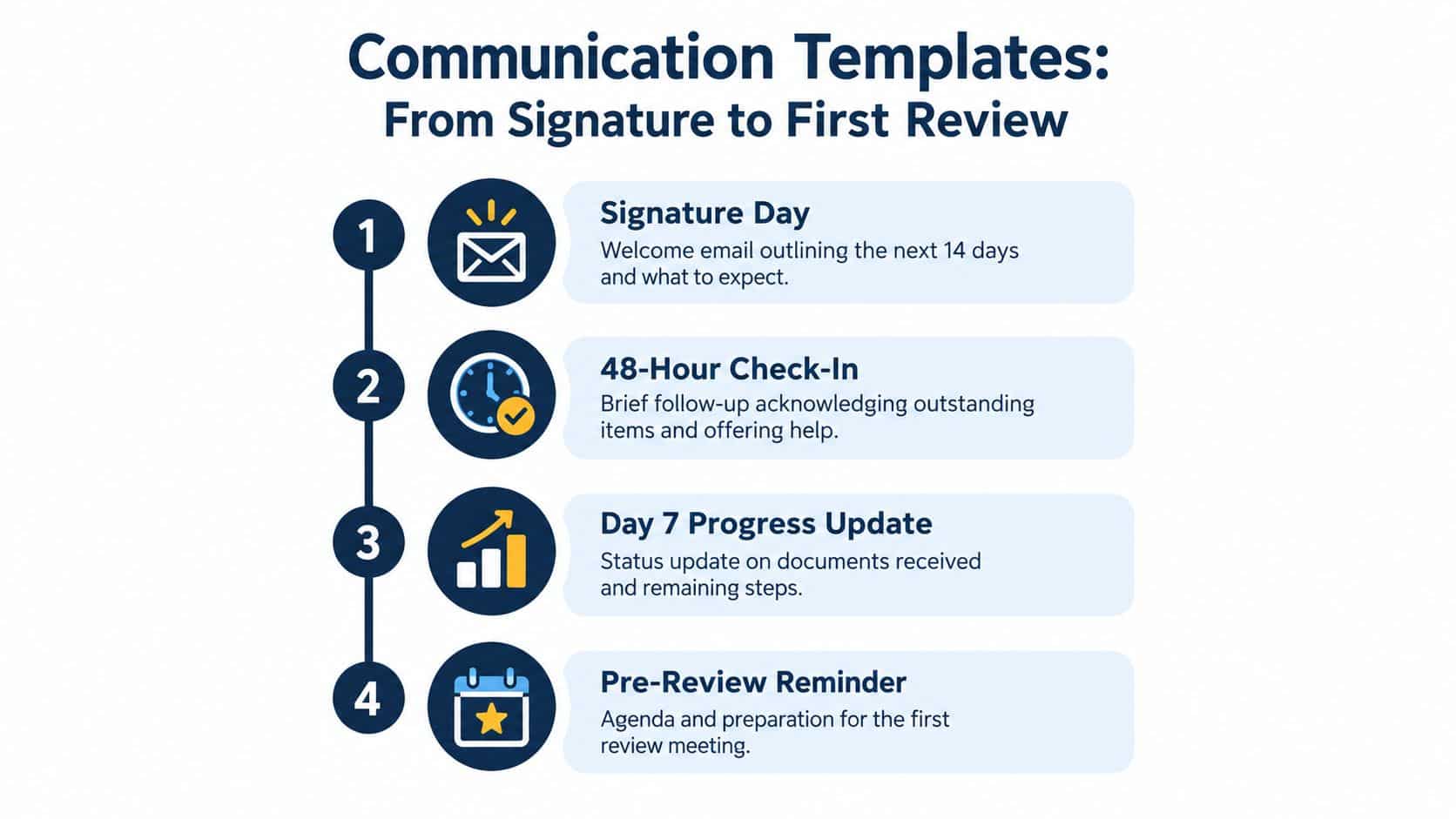
Signature-day welcome email
Subject line: Welcome. Here's what happens over the next 14 days
Opening line: Thank you for signing today. The onboarding process is now underway, and this note outlines each next step.
Body:
Confirm that the engagement is active. Name the operations contact. Explain that the client will receive secure document requests, disclosure materials, and scheduling details for the first review. Keep the timeline simple and visible.
Call to action:
Please watch for the secure document link and send any immediately available items there.
48-hour check-in and Day 7 update
The 48-hour message should be short.
Subject line: Quick onboarding check-in
Opening line: This is a brief update to confirm receipt of the items already submitted.
Body:
List what has been received. Name only the missing items that still matter. Offer help if the client has questions about any request.
Call to action:
Reply to this message or contact the operations team if any item is difficult to locate.
By Day 7, the client should get a real status note.
Subject line: Onboarding status and remaining items
Opening line: The team has completed the initial review and the file is moving forward.
Body:
Summarize progress. Confirm whether identity review is complete, whether account forms are in process, and whether transfer or funding steps are ready. Include the KYC collection link if documents are still outstanding.
Call to action:
Upload the remaining items using the secure link so the team can move to final account setup.
A good status email lowers anxiety. A vague status email creates another reply chain.
Day 14 milestone and 60-day review invitation
The Day 14 message should mark progress, not just ask for more work.
Subject line: Account approval and funding steps
Opening line: The account setup process has reached the approval stage.
Body:
Confirm approvals that are done, explain funding instructions, and tell the client what to expect next. This is the point where many firms either build confidence or trigger preventable support tickets with rushed instructions.
Call to action:
Review the funding instructions and confirm once the transfer has been initiated.
The 60-day invitation turns onboarding into relationship management.
Subject line: Schedule your first review meeting
Opening line: The first review is the point where the team confirms setup, progress, and priorities for the months ahead.
Body:
Include a short agenda: account status, planning priorities, service calendar, and open questions. The client should understand this meeting is not ceremonial. It's where the firm proves continuity after setup.
Call to action:
Choose a meeting time using the scheduling link or reply with preferred availability.
Onboarding Complex Households and Entity Clients Without Losing the Timeline
A straightforward individual account can move cleanly. A complex household can turn the same workflow into a coordination project.
Joint accounts, trusts, family groups, LLCs, S-corps, and foundations don't just add documents. They add decision-makers, legal reviewers, and approval dependencies. That's why many firms think they have a document problem when they really have an ownership problem.
Where complexity actually enters the workflow
Trusts bring trustee authorization, fiduciary certificates, and signatory verification. Entities bring beneficial ownership review, EIN verification, operating agreement review, and authority documentation. Family groups often add one more challenge: several people want visibility, but only certain people can approve or sign.
A single umbrella workflow starts to fail. The firm needs to know whether it is onboarding one household with one economic decision-maker, or one relationship with multiple legal tracks.
The moves that keep the file from stalling
Three coordination habits matter more than technology.
Collect in parallel when possible
Waiting for one packet to finish before starting the next usually extends the timeline for no good reason.Assign one internal owner per entity type
If trust files bounce between several staff members, delays multiply.Hold a weekly internal standup until funding
Advisor, operations, and compliance should review open items together, especially when outside professionals are involved.
Automation helps with reminders. It doesn't solve ambiguity about who owns the next decision.
This becomes especially important for high-complexity clients because industry coverage has pointed out that automation alone doesn't fix coordination weaknesses in onboarding for complex households and entity clients, particularly where beneficiaries, authorized signers, attorneys, and CPAs must align, as discussed in this overview of complex financial client onboarding challenges.
How to handle outside-professional delays
CPAs and attorneys often aren't slow because they object. They're slow because the request sent to them was vague.
A better escalation note is specific. It should state the document needed, why it's needed, who must sign, and the deadline tied to the client's target funding date. Keep the tone neutral. Escalation should reduce friction, not advertise internal frustration.
When one branch of the household starts holding up the rest, split the workflow. For example, a spouse's individual account, a joint account, and a family trust may need related communication but separate tracking. Forcing all three through one checklist usually hides bottlenecks instead of resolving them.
Measuring Whether Your Onboarding Process Is Actually Working
Many firms think onboarding is working because the team is busy and accounts eventually open. That isn't the right test.
The question is whether the process produces a funded account, a confident client, and a clean handoff into ongoing service without unnecessary rework. That requires instrumentation from signed agreement through first review.
The metrics worth tracking
A practical scorecard should combine operational and relationship signals.
| Metric | Stage | Frequency | Red Flag Threshold |
|---|---|---|---|
| Time to funded account | Post-signature through funding | Weekly | Trend moving later without a clear complexity reason |
| Document error rate | Intake and compliance review | Weekly | Repeat exceptions from the same document types |
| KYC turnaround | Identity review stage | Weekly | Files waiting without clear ownership |
| Forms returned | Early intake | Weekly | Large volume of unsigned or incomplete packets |
| IPS signed | Pre-implementation | Weekly | Planning files reaching implementation without final signoff |
| Post-onboarding satisfaction | First 30 to 90 days | Monthly or quarterly | Repeated confusion about next steps or point of contact |
| 12-month retention | Relationship year one | Quarterly | Early attrition tied to weak first-month experience |
Industry guidance on onboarding design supports measuring beyond raw completion speed. Coverage focused on advisory onboarding has noted that the gap between digital form completion and the first 30 to 90 days of service delivery is often where trust is either reinforced or lost, and that strong programs should be measured not only by completion time but also by error rates and post-onboarding satisfaction, as discussed in this wealth management view of workflows and onboarding design.
Leading indicators and lagging indicators
Leading indicators tell the firm whether the process is healthy right now. Lagging indicators show whether the process produced the right relationship outcome later.
Leading indicators include:
- Forms returned on time
- Identity review turnaround
- Outstanding document aging
- Whether the first review is scheduled before onboarding drift sets in
Lagging indicators include:
- Retention over the first year
- Expansion into additional account types
- Referral activity after the relationship stabilizes
NASAA's suitability documentation guidance also reinforces that client information collected during onboarding should be updated periodically, for example during client meetings or at least annually, and that onboarding records should cover identifying details, financial details, and investment objectives such as time horizon, liquidity needs, tax considerations, risk tolerance, and experience, as explained in NASAA's guidance on documenting suitability. That means the first review is not separate from onboarding quality. It is one of the first tests of whether the collected data was complete and usable.
Warning signs that the workflow is failing
A failing onboarding process usually shows itself before anyone labels it a problem.
Watch for these signs:
- Clients ask who their point of contact is more than once
- Operations sends repeated requests for documents already submitted
- Suitability data and custodial paperwork don't match
- The first review gets scheduled only after the account is funded, not while the file is moving
- Compliance exceptions cluster around the same stage every month
The SEC's adoption of Regulation Best Interest and Form CRS on June 5, 2019, with a compliance date of June 30, 2020, marked a clear turning point for onboarding because broker-dealers had to begin complying with Reg BI and broker-dealers plus SEC-registered investment advisers had to prepare, deliver, and file the relationship summary used during retail-client onboarding, with the SEC stating that the goal was to significantly enhance the quality and transparency of relationships between firms and retail investors, as described in the SEC's Reg BI and Form CRS overview. Since then, onboarding has been inseparable from disclosure control, relationship definition, and first-impression quality.
A separate onboarding survey discussed in an advisory industry article also said only 7% of respondents onboard a new client in less than one month, while 79% require one to three months and 14% need four to six months, reinforcing that cycle-time reduction is a measurable priority for larger firms, as noted in this summary of institutional onboarding benchmarks.
A 30 60 90 rollout plan that doesn't drift
A useful redesign needs owners and decision gates.
First 30 days
Audit the current intake flow. Map every handoff from advisor to operations to compliance. Decide whether the firm will stay paper-based, move to hybrid, or tighten a digital approach already in place. The deliverable is a current-state workflow map with named owners.
By 60 days
Rebuild the templates, reorder the KYC and disclosure sequence, and define the handoff choreography. The deliverable is a future-state onboarding playbook with communication templates, ownership rules, and exception handling.
By 90 days
Pilot the process with a small cohort. Measure funded-account timing, document errors, outstanding item aging, and client feedback after the first review. The deliverable is a pilot readout with keep, fix, and scale decisions.
One implementation option firms sometimes evaluate during this phase is Advisor Momentum's coaching around new client onboarding and client service workflows, particularly when the need is process design and team training rather than just marketing support.
The point of the rollout isn't to create a prettier checklist. It's to make the financial advisor client onboarding process predictable, compliant, and confidence-building from the first signature through the first real review.
Advisor firms that want tighter onboarding, cleaner handoffs, and compliance-aware client communication can use Advisor Momentum for support across workflow design, content, coaching, and digital systems that fit regulated practices. For firms that are serious about turning onboarding from an admin burden into a client-confidence engine, it's worth reviewing how that support aligns with the current process gaps.
